The Spanish Jet Ski Licence: How to Get One (and When You Don't Need It)
Here’s the answer most people actually need: you don’t need any licence to jet ski in Costa Adeje — not for the beach circuits, not for the one-hour safaris, not for the three-hour run to Los Gigantes. Every guided ride out of Puerto Colón is legal for complete beginners, because Spanish law treats a supervised rental as the operator’s responsibility, not yours. If that’s all you came to check, you’re done — go pick a route on the main Costa Adeje guide.
But if you’ve ever watched the guide peel off and thought I want to do this on my own terms — throttle when I like, stop where I like, no convoy — then you need Spain’s entry-level nautical qualification: the Licencia de Navegación, universally nicknamed the titulín. It’s a six-hour course with no exam, it can be done right there in Puerto Colón, and it’s surrounded by more outdated internet advice than almost any other paperwork in Spanish boating. This page untangles it properly: what the licence covers, what it costs, what happened to the old Patrón de Moto Náutica system that half the web still describes, whether your RYA or ICC certificate counts, and what self-hire actually looks like in Tenerife once you’re licensed.
The short answer, in one table
| What you want to do | What you need |
|---|---|
| Guided safari or beach circuit (any duration, any ski) | Nothing — just ID, a waiver, and being 16+ to drive (parental consent under 18) |
| Ride as a passenger | Nothing — roughly age 7–8 and 1.30 m minimum with most operators |
| Hire a ski and ride unsupervised | Licencia de Navegación (or a higher Spanish title: PNB, PER, Patrón de Yate, Capitán de Yate) |
| Ride unsupervised beyond 2 nautical miles | A higher title than the titulín — PNB (5 miles) or PER (12 miles) |
| Ride at night | Nobody — Spanish rules confine jet skis to daylight hours (roughly an hour after sunrise to an hour before sunset), whatever licence you hold |
| Bring or buy your own ski in Spain | A valid title plus registration and third-party insurance — a separate rabbit hole; check with the Capitanía Marítima |
When you genuinely don’t need a licence
Spanish regulations carve out supervised rentals — and that carve-out is the entire holiday jet ski industry. When you book a jet ski safari or a 20-minute circuit in Costa Adeje, the operator holds the qualifications, provides a briefed guide or monitor, keeps you inside their authorised zone, and insures the whole thing. Your side of the bargain is to be old enough — 16 with a parent’s signed consent is the national rule for driving, and operators require 18 to ride with a passenger on the back — to sign the waiver, and to follow the briefing.
That’s not a grey area or a tourist-office fudge — it’s how the rules are written, and it’s why operators can put a total beginner on a 130 hp machine after a ten-minute briefing. The trade-off is structure: you ride the operator’s route, in convoy, at the pace the guide sets, inside their permitted area. For most visitors that’s not a limitation at all — the guides know where the coastline is worth seeing and the convoy format is what makes a first ride feel safe. If you’ve never ridden, the first-timer’s guide walks through exactly what the briefing covers.
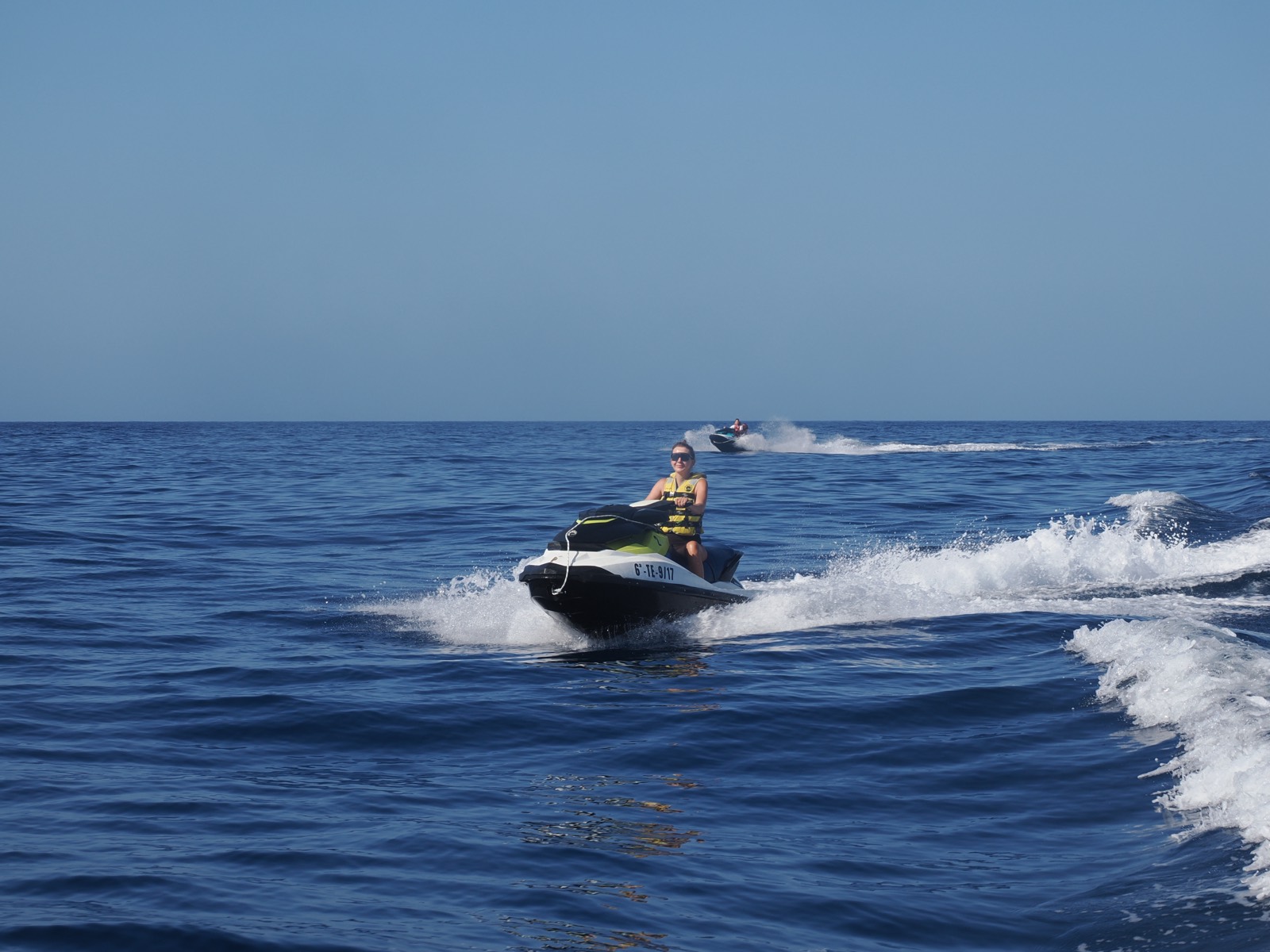 The guided convoy: legally the operator’s responsibility, which is why no licence is needed.
The licence that matters: the Licencia de Navegación (“titulín”)
Since 1 July 2019, the Licencia de Navegación is the one qualification that unlocks unsupervised jet ski riding in Spain. Real Decreto 238/2019 amended the recreational boating rules (Real Decreto 875/2014) so that the titulín now covers motos náuticas with no power limit — a 300 hp supercharged ski and a 90 hp runabout need exactly the same piece of paper.
What you get, and what it takes:
| Licencia de Navegación | |
|---|---|
| Allows | Motorboats up to 6 m; jet skis of any power |
| Range | Up to 2 nautical miles from a port, marina or shelter — daytime only |
| Course | ~6 hours total: 2 h theory + 4 h practical, at an accredited nautical school |
| Exam | None — the only Spanish nautical title with no exam; the school issues it directly |
| Typical cost | €90–150 all-in at most schools |
| Minimum age | 18, or 16–17 with signed parental consent |
| Medical | Required by law — a psychotechnical fitness report (the same type used for Spanish driving licences, ~€30–50, valid two years); some schools arrange it or bundle it into the course price, so confirm the logistics when you book |
| Validity | Issued for life — no ten-year renewal cycle like the PNB or PER |
The theory block covers the basics you’d hope a solo rider knows: buoyage, right-of-way, the safety kit a ski must carry, and where you’re allowed to ride. The four practical hours are boat and ski handling — leaving and entering a berth, manoeuvring, what to do when something goes wrong. There is no test at the end; turn up, complete the hours, and the school processes your licence. Some schools issue paperwork the same day.
Two honest caveats. First, the 2-mile daytime limit is real: with only a titulín you can’t legally take a hired ski to Los Gigantes on your own — that run is roughly 20 km each way, well outside the licence’s range, which is one reason the long safaris are guided convoys. And “daytime” is strict for jet skis specifically: Spain’s moto náutica rules only permit them on the water between roughly an hour after sunrise and an hour before sunset — no licence, however senior, buys a night ride. Second, the licence covers Spanish rules; each autonomous community and port authority also sets local zones, and the national rules ban skis from marked bathing zones outright and from the 200 m shore strip except when heading in or out through marked channels at no more than 3 knots. A licence is permission, not a map — where you can actually ride is its own subject.
What happened to the Patrón de Moto Náutica?
If you’ve researched this before, you may have read that jet skis over 110 hp need a “Patrón de Moto Náutica A”. That was true — until 1 July 2019. The old system, dating from Real Decreto 259/2002, sliced jet skis into three power classes with a licence for each:
| Old title (pre-July 2019) | Covered |
|---|---|
| Patrón de Moto Náutica A | Skis of 110 hp (CV) and above |
| Patrón de Moto Náutica B | Over 55 and under 110 hp |
| Patrón de Moto Náutica C | 55 hp and under |
Real Decreto 238/2019 scrapped the lot. The Ministry of Transport confirms that Patrón de Moto Náutica titles can no longer be obtained; certificates issued before 1 July 2019 keep their validity for their holders, but everything a Patrón A could do on a ski is now covered by the humble titulín. Any article, forum post or school page still telling you a rental ski’s horsepower dictates which of three licences you need is describing a system that no longer exists — worth knowing, because plenty of first-page search results haven’t been updated.
The practical consequence is huge: the barrier to legal solo riding in Spain dropped from a multi-class exam system to one six-hour, no-exam course.
Doing the course in Tenerife
You don’t need to fly home and come back qualified — Tenerife has accredited nautical schools, including one at the very marina the safaris leave from:
- Escuela Náutica Tenerife operates from Marina Puerto Colón (Pantalán 8) and runs the Licencia de Navegación with theory, practical and paperwork handled for around €150. You could plausibly do the course one day and be riding unsupervised the next.
- Escuela Náutica de Santa Cruz de Tenerife (run through Náutica y Deportes in the capital) teaches the Spanish titles from the titulín up to Patrón de Yate.
- Several mainland schools also run online theory plus in-person practical formats from roughly €99 — fine if you want the reading done before you land, but the practical hours must still happen in person.
Three things to check when booking, because they vary school to school: whether the course runs in English (many run in Spanish by default and offer English on request), how the medical works — the psychotechnical fitness report is a legal requirement, but some schools arrange it for you while others expect you to turn up with one — and how quickly they issue the licence: same-day at some schools, a week or two of processing at others. If your riding window is a one-week holiday, ask before you pay.
Do foreign licences work? RYA, ICC and EU qualifications
This is the murkiest corner of the whole subject, so here it is as straight as the sources allow.
For boats, Spain’s Merchant Marine directorate confirmed in May 2021 that it recognises a list of RYA certificates for skippering Spanish-flagged craft — the Yachtmaster family, Day Skipper, Powerboat Level 2 and the ICC. EU and EEA nationals can generally use their home country’s equivalent qualifications too.
For jet skis specifically, the picture is narrower. The ICC’s personal watercraft category is generally not accepted for Spanish-flagged skis, and the RYA’s dedicated Personal Watercraft Proficiency certificate does not appear on Spain’s recognised list. Some Tenerife rental operators say they accept “other international licences” alongside the Spanish titles — but that’s the operator’s commercial judgement meeting their insurer’s terms, not a guarantee written in law.
So the honest advice is boring but reliable: email the rental company a photo of your certificate before you book, and get their yes in writing. If they say no — or you’d rather not gamble a holiday morning on it — the titulín course costs about the same as two hours of self-hire and removes the question permanently. Holders of a Spanish PNB or PER are covered regardless: both include everything the titulín does.
Once you’re licensed: self-hire in Tenerife
Licensed self-hire exists in Costa Adeje, but it’s a niche product — only a handful of operators offer it, because the mass market neither has nor needs a licence. The established option sits in Puerto Colón itself: JetScoot (Pantalán 3) rents skis to licence holders with no instructor aboard and no convoy, advertised online at €80 for one hour, €150 for two and €199 for three, fuel included, with a passenger riding free. Bring the original licence document — not a photo — and expect a deposit of around €200 per ski, returned after the ride.
Compare that with the guided market — 1-hour safaris at €90–120, 2 hours at €130–160 — and the picture is more nuanced than “self-hire is cheaper”: at one hour it clearly undercuts the safaris (€80 against €90–120), but over two and three hours the prices converge with the discounted guided rates. What you’re really buying is the freedom to set your own pace. The freedom has edges, though: you’re bound by your licence’s 2-mile daytime range, the port’s authorised areas, and the bathing-zone speed rules, and the Guardia Civil does patrol the strip in summer. The same kit rules apply as on any ride out of the marina: life jacket on, kill cord clipped, phone in the locker ashore.
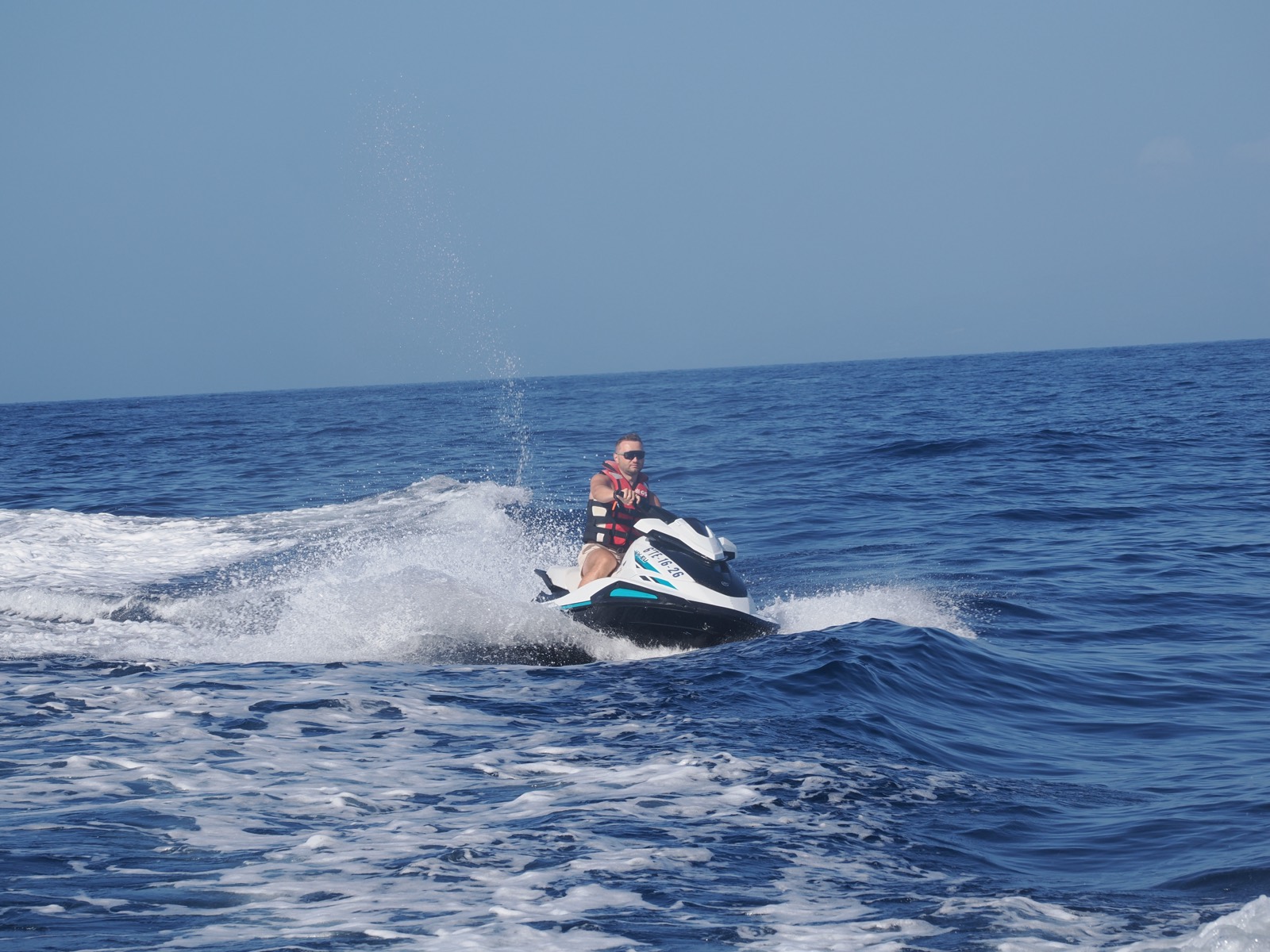 What the licence buys: open water, your own throttle, nobody’s convoy.
Is it worth getting for a holiday?
Run the numbers against your realistic riding time. The licence costs €90–150 plus a day of your holiday, and the per-hour savings on self-hire are modest — €10–40 on a one-hour ride, close to nothing on longer runs against discounted guided rates. On a one-week trip with a single ride planned, the course cannot pay for itself — book the safari, enjoy having a guide who knows where the water is calm and the coastline is worth the fuel. The honest case for the licence was never arithmetic anyway: it starts making sense if any of these apply — you’ll ride several times, you come back to Tenerife (or anywhere in Spain) most years, you actively dislike convoy riding, or you’re curious about small-boat hire too — the same paper covers motorboats to 6 m, and plenty of Tenerife boat-hire outfits rent to titulín holders.
And if you do the course at Puerto Colón, there’s a neat symmetry: the pontoon where you fumble your first solo docking is fifty metres from the gates where the safari convoys load up. Either way, you end up on the same water.
Frequently asked questions
Do I need a licence to ride a jet ski in Tenerife?
Not for any guided activity. Safaris, circuits and supervised rentals are legal for unlicensed riders under Spanish rules — the operator’s qualifications and insurance cover the activity. You need to be 16 to drive (with signed parental consent if under 18), and operators require 18 to carry a passenger. A licence — the Spanish Licencia de Navegación or a recognised equivalent — is only required to hire a ski and ride it unsupervised.
How long does it take to get the Spanish jet ski licence?
About six hours of course time: two hours of theory and four of practical training at an accredited nautical school. There is no exam — the Licencia de Navegación is the only Spanish nautical title issued without one. Some schools hand over the licence the same day; others take days or weeks to process paperwork, so ask before booking if you’re on a holiday timetable.
How much does the Licencia de Navegación cost?
Typically €90–150 all-in, depending on the school. Tenerife courses run around €150 including paperwork; some mainland schools with online theory start near €99. On top of that, the law requires a psychotechnical fitness report — the same type used for Spanish driving licences, typically €30–50 — so check whether your school bundles it into the price or expects you to bring one.
Is there a power limit on jet skis with the titulín?
No. Since Real Decreto 238/2019 took effect on 1 July 2019, the Licencia de Navegación covers motos náuticas of any power. The old three-tier Patrón de Moto Náutica system — where skis over 110 hp needed a Patrón A — was abolished on the same date. Advice about horsepower classes still circulating online describes the pre-2019 rules.
Does an RYA or ICC certificate let me hire a jet ski in Spain?
Not reliably. Spain recognises several RYA certificates and the ICC for boats, but the ICC’s personal watercraft category is generally not accepted for Spanish-flagged skis, and the RYA Personal Watercraft Proficiency certificate isn’t on the recognised list. Individual rental companies may accept international licences at their discretion — confirm in writing with the operator before booking, or take the six-hour Spanish course and settle it.
Can a 16-year-old get the Spanish jet ski licence?
Yes. The minimum age for the Licencia de Navegación is 18, but 16- and 17-year-olds can obtain it with the documented consent of a parent or guardian — the same age logic operators apply on guided rides. Carrying a passenger on a ski remains an 18+ privilege with the operators regardless of licence status.
Does the Licencia de Navegación expire?
No — schools issue it for life, with no renewal cycle. That’s another way it differs from the higher Spanish titles like the PNB and PER, which run on ten-year renewable cards. Get it once at 20 and it’s still valid for a Tenerife trip at 60, though rental operators will always apply their own checks, deposits and briefing on the day.